 (02) 9687 6000

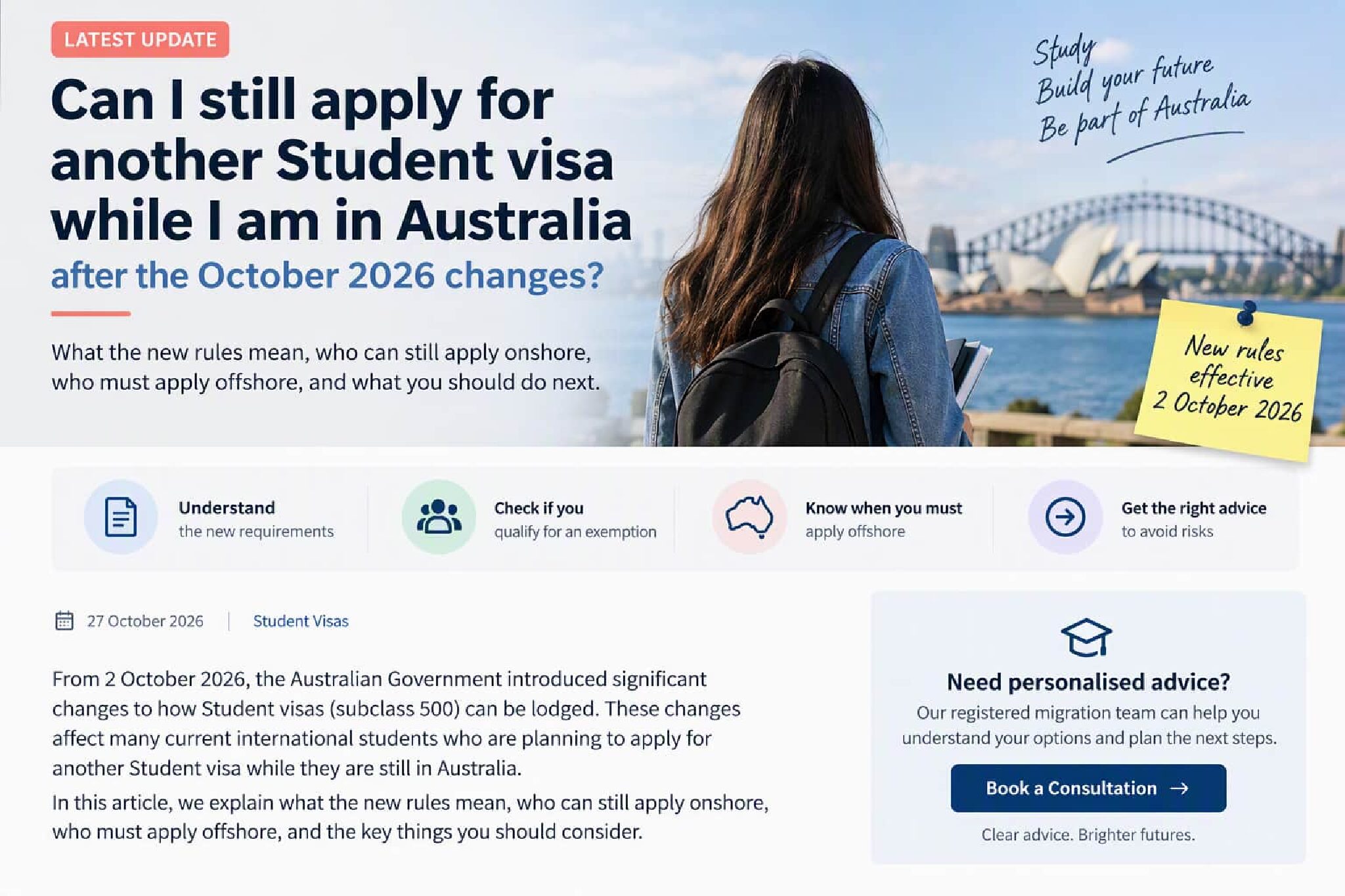
Can I Still Apply for Another Student Visa While I Am in Australia After the October 2026 Changes?
27 October 2026
From 2 October 2026, new rules change who can apply for a Student visa (subclass 500) while they are in Australia. Most people who are already in Australia, including most Student visa holders who want another Student visa, now need to be outside Australia when they lodge the application. If you are required to apply from outside Australia, you must also be outside Australia when the visa is granted.
A Student visa you already hold is not affected. You can still apply for a Student visa if you meet the visa requirements. Whether the next application can be lodged in Australia depends on the visa you hold now and, if you are the primary Student visa holder, on a short list of exemptions.
This article explains the published rules. It is not advice about your own application. CK Migration’s immigration services can assess your visa and your study circumstances with you.
The rules started on 2 October 2026
The Migration Amendment (Student Visa Reform) Regulations 2026 commence on the day after that instrument was registered. The Federal Register of Legislation records the commencement date as 2 October 2026. The Department of Home Affairs and Study Australia both state that the new rules apply from 2 October 2026.
Those amendments apply to a visa application made on or after commencement. The Department of Home Affairs states that a Student visa application lodged before 2 October 2026, including an application that included family members, continues to be assessed under the rules that were in place when it was lodged.
From 2 October 2026 there are also new limits on including family members in a Student visa application. Those limits are separate from the question of where you may lodge. The Department’s pages linked at the end of this article set out when family members can be included.
Most temporary visa holders cannot apply in Australia
From 2 October 2026, most Student visa applications must be lodged outside Australia. The Department of Home Affairs states that you can apply in Australia only if you hold an eligible visa and meet an exemption.
If you hold one of the following visas, as a primary holder or as a secondary holder, you cannot apply for a Student visa in Australia. The Department states that there are no exemptions to this rule.
- Subclass 400 – Temporary Work (all streams)
- Subclass 403 – Domestic Worker (Diplomatic or Consular) stream
- Subclass 407 – Training (all streams)
- Subclass 408 – Temporary Activity (all streams)
- Subclass 417 – Working Holiday (all streams)
- Subclass 457 – Temporary Work (all streams)
- Subclass 462 – Work and Holiday (all streams)
- Subclass 482 – Skills in Demand / Temporary Skill Shortage (all streams)
- Subclass 485 – Temporary Graduate
- Subclass 600 – Visitor
- Subclass 601 – Electronic Travel Authority
- Subclass 602 – Medical Treatment
- Subclass 651 – eVisitor
- Subclass 771 – Transit
- Subclass 988 – Maritime Crew
- Subclass 995 – Diplomatic (Temporary), for the primary holder
For subclass 995, the Department states that the restriction applies to the primary holder, and that a family member of a Diplomatic (Temporary) visa holder can apply for a Student visa in Australia. The legislative instrument specifies a subclass 995 holder who was granted that visa on the primary criteria in Division 995.2 of Schedule 2 to the Migration Regulations 1994.
If you hold one of these visas, you can only apply from outside Australia, and you must be outside Australia when the Student visa is granted.
If you already hold a Student visa
There are new rules for a Student visa holder who wants another Student visa while in Australia. Unless you meet a limited exemption, you need to be outside Australia when you lodge the application, and outside Australia when the visa is granted.
The changes do not affect the Student visa you hold now.
If you hold a Student visa as a dependant and you want to apply for a Student visa as the primary applicant, you must lodge the application from outside Australia and be outside Australia when the visa is granted. The Department of Home Affairs states that there are no exemptions to this rule. The Migration Regulations lead to the same result: the onshore exemption classes apply only where the person already holds the Student visa on the primary criteria.
Current Student Guardian (subclass 590) visa holders can continue to lodge a further Student Guardian visa application while in Australia. That is a different visa from a further Student visa.
When a primary Student visa holder may apply in Australia
If you hold the Student visa as the primary applicant, the Department says you may be able to apply for another Student visa in Australia if you meet one of six exemptions. Those exemptions are the classes set out in the Migration Regulations and in the current compilation of LIN 20/158. A dependant who wants to become the primary applicant is not in these classes.
If you do not meet an exemption, the Department says you should not apply in Australia. It will not accept an application from a person who is not eligible to lodge in Australia.
Up to 12 further months to finish your course
- you need up to 12 additional months from the original end date of your main course to finish the course; and
- if you have a package of courses, the course you need more time to complete must be the main course; and
- the course must be with the same education provider that your current Student visa was granted for. The Department states that you can have changed courses, but the course you changed to must be at the same AQF level or higher.
The Department gives this example: a student who has started a bachelor degree can apply in Australia if they need up to 12 extra months to finish that degree, or a different bachelor degree, at the same education provider.
Sponsored by DFAT or Defence
The Department states that you must be sponsored by the Department of Foreign Affairs and Trade or the Department of Defence. In the Migration Regulations, the related classes are Defence students and Foreign Affairs students.
A doctoral degree
The Department states that you must be applying to study a doctoral degree (PhD). You cannot use this exemption to apply for a master’s by research course. LIN 20/158 describes the class as a person seeking the primary criteria who, at the time of application, is enrolled in a course of study leading to a doctoral degree.
Primary or secondary school
The Department states that you must be applying to study primary or secondary school. In the Migration Regulations, the related class is a school student within the meaning of clause 500.111 of Schedule 2.
Your education provider has defaulted
The Department states that this exemption is for a person who cannot continue their course because their education provider has defaulted.
In LIN 20/158, this class is narrower than a general statement that a provider has closed. At the time of application the person must be seeking the primary Student visa criteria and must have been unable to complete a registered course because of provider default. They must have been enrolled in that course on the provider default day, need a further Student visa to complete an alternative registered course or other registered courses after an alternative course, apply within 12 months after the provider default day, and not have already made a visa application because of the same provider default.
You have completed your main course and are progressing to a further course
A primary Student visa holder may be able to apply for another Student visa in Australia after completing the principal course the current visa was granted for, or an alternative principal course that was not inconsistent with the conditions of that visa. At the time of application, the person must be seeking to meet the primary criteria and must be enrolled in no more than one further course of study.
Where that completed principal course has an Australian Qualifications Framework (AQF) level, the further course must be at a higher AQF level. If the completed course was a higher education course, the further course must also be a higher education course delivered by a higher education provider.
Where the completed principal course does not have an AQF level, the further course must have an AQF level, unless the person was a school student when they undertook the principal course. The Department of Home Affairs gives these examples:
- A student who has completed an English Language Intensive Courses for Overseas Students (ELICOS) course may apply in Australia to progress to a bachelor degree.
- A student who has completed an ELICOS course cannot use this exemption to apply in Australia for another ELICOS course.
- A student who has completed secondary school may apply in Australia for a foundational course.
- A student who has completed a bachelor degree at a higher education provider cannot use this exemption to apply in Australia for a graduate diploma at a vocational education and training provider.
The Department also explains that this exemption can apply where you have completed the main course your visa was granted for, or a course at the same or a higher AQF level as the original course. If you do not meet this exemption, you need to lodge the next application from outside Australia.
Packaged courses
If you hold a Student visa and meet an exemption that allows you to apply for a further Student visa in Australia, you cannot package courses together unless you are applying:
- to undertake primary or secondary school studies
- to study a doctoral degree, or
- for a further visa because your education provider has defaulted.
If you are applying under the course progression exemption, you cannot package courses. You must be enrolled in only one future course of study when you apply. The Department states that if you are enrolled in more than one future course, you will not meet the requirements for a valid application.
You are expected to begin the next course at the first available intake after completing your current course. The Department says the gap between courses should be minimal and, in most cases, no longer than two calendar months during the teaching year, or four calendar months between standard academic years.
For example, a Year 12 student relying on the course progression exemption cannot apply in Australia for a package made up of a foundation course followed by a bachelor degree, and needs to apply from outside Australia. A person who has finished a bachelor degree and wants to undertake a graduate certificate and a master’s degree also needs to apply from outside Australia.
You must be outside Australia when the visa is granted
If you are required to lodge the application from outside Australia, you must also be outside Australia when the Student visa is granted. That includes affected temporary visa holders, and Student visa holders who do not meet an exemption. It also includes a person who holds a Student visa as a dependant and wants to apply as the primary applicant.
You may return to Australia on another valid visa while the Student visa application is being processed, but you must be outside Australia when the Student visa is granted. You will not receive a bridging visa linked to an application lodged outside Australia.
Applications lodged before 2 October 2026
Student visa applications lodged before the new rules started on 2 October 2026, including applications that included family members, continue to be assessed under the rules that were in place when they were lodged. A Student visa you already hold is not changed by these rules.
An onshore application can be invalid
If you lodge a Student visa application in Australia when you are required to lodge it from outside Australia, the application will be invalid. If you do not meet an exemption, you should not apply in Australia. The Department states that it will not accept an application if you are not eligible. An invalid application outcome could affect your visa status, and you may not be eligible to apply for a further visa if your visa has already expired. The Department also states that invalid decisions cannot be merits reviewed at the Administrative Review Tribunal.
If you include a family member who is not eligible to be included, that family member’s application will be invalid. Whether a family member can be included depends on separate rules. The Department’s Student visa changes pages set out those rules.
Need advice about your next Student visa?
CK Migration can assess your current visa and study circumstances and advise whether you may be eligible to lodge another Student visa from within Australia or need to apply offshore.
Book a ConsultationOfficial sources
The information in this article is drawn from these Australian Government sources.
- Department of Home Affairs — Changes to Student visa application rules (subclasses 500 and 590)
- Department of Home Affairs — Applying for a Student visa or Student Guardian visa while in Australia
- Department of Home Affairs — What you need to do
- Department of Home Affairs — Student visa (subclass 500)
- Migration Amendment (Student Visa Reform) Regulations 2026
- Migration (Student Visa Applications to Be Made from outside Australia) Instrument 2026
- Migration (LIN 20/158: Class of Persons for Student (Temporary) (Class TU) Visa Applications) Instrument 2020 — compilation in force on 2 October 2026
- Study Australia — Student visa changes from 2 October 2026